Tamera
A 'Peace Research & Education Center' in rural Portugal built around the concept of 'Healing Biotopes' — communities designed to research and model a nonviolent culture across ecological, social, and spiritual domains.
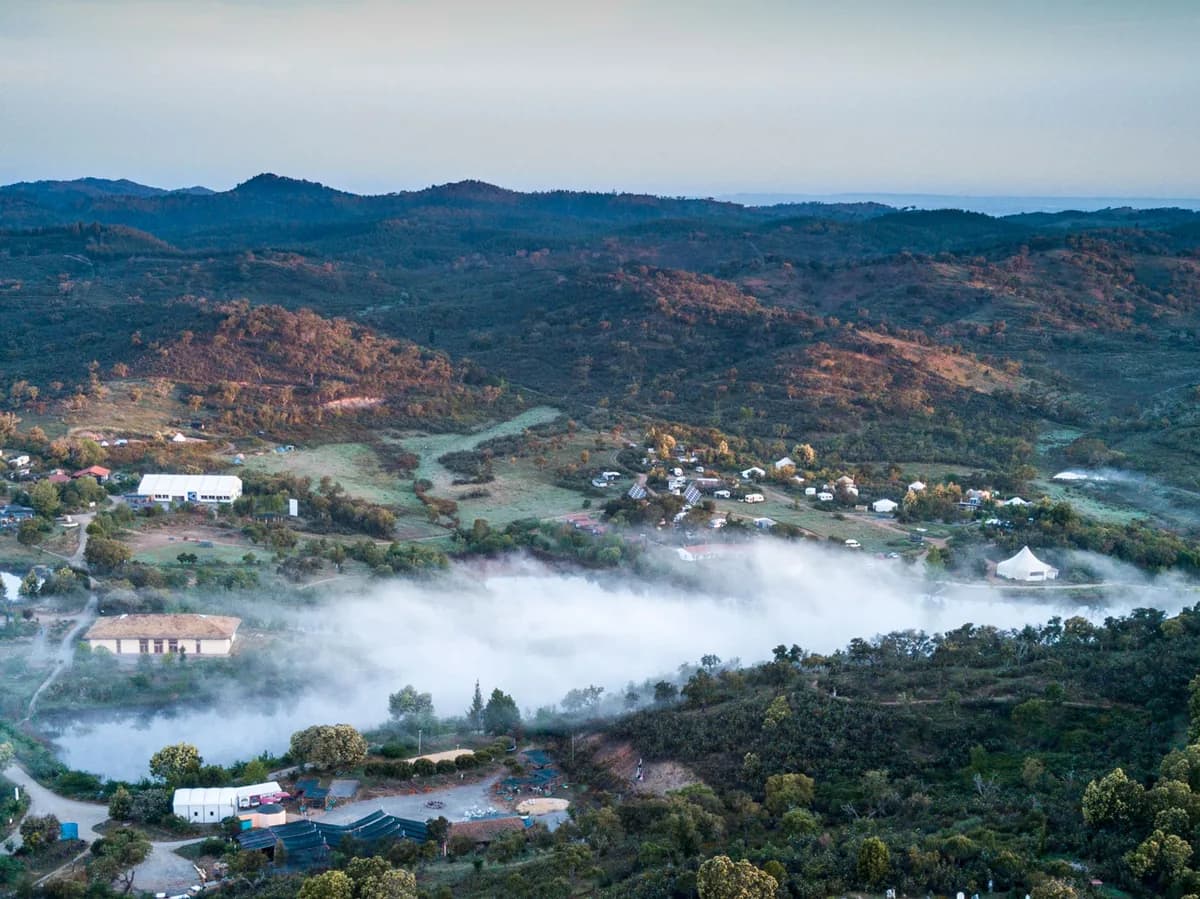
- Tamera states its mission as supporting 'a global system change from war to peace, from exploitation to cooperation, from fear to trust,' pursued through three stated functions: Research, Education, and Outreach.
- The 'Healing Biotopes' concept is described as research centers that 'model a nonviolent culture' — named research areas include 'Healing of Love' (sexuality and relationships), Community Building, Ecology, water-retention landscape design, and decentralized solar energy ('Cooperation with Light').
- Co-founder Dieter Duhm is directly quoted: 'There is the world that we create, and there is the world that has created us. These two worlds must come together. This is the goal of our journey.'
- Recent activity described on the site's own news feed (2026) includes participation in the 'Global Sumud Flotilla' and water-regeneration work following winter storms in Portugal — concrete, dated, checkable current activity rather than only founding-era claims.
Directly quoted and named as co-founder on the site — an independently documented figure (German sociologist and author) predating Tamera's founding.
Named in a 2026 Tamera news post as an initiative the community returned from — a real, independently checkable named event, not yet independently verified for Tamera's specific role in it.
EVERY NAME LINKS TO ITS PAGE ON THE MAP — SEE WHO ELSE CITES IT. NAMING A SOURCE IS NOT ENDORSING IT.
- What does a 'Healing Biotope' actually consist of operationally, beyond the branding language — is it a legal/land structure, a research methodology, or primarily a community identity?
- Tamera's 'Healing of Love' research area explicitly addresses sexuality and relationships — what does this involve in practice, and how (if at all) is it evaluated as research rather than described as lifestyle or belief?
- What is Tamera's actual current population and residency/membership process?
Tamera frames itself explicitly as a research center rather than a retreat or eco-village, which is a genuinely different register from most other Communities entries — its own site leads with 'Research, Education, Outreach' before any lifestyle or spiritual framing.
The water-retention landscape and decentralized solar work ('Cooperation with Light') is the most concretely technical/ecological claim among the community entries researched so far — worth a deeper look on its own terms, separate from the community's broader relational and spiritual research areas.
SOURCE: tamera.org (scraped 2026-07-09)
What is Tamera's actual current population, and has any of its water/ecological research been independently assessed?
Not stated on the homepage — the Atlas is tracking for population figures and any independent (non-Tamera) assessment of its water-retention landscape work.
Report from the field →SeedHome
A compression-only prefab bio-shelter built from curvilinear shell geometry and decentralized robotic fabrication — the flagship product of Bio-Veda's bio-architecture academy and blueprint-licensing business.
Science and Alchemy of Consciousness (France)
A real, currently-running annual multi-day conference and retreat — its 5th year in 2025 — bringing the Implosion Group's device makers, theorists, and practitioners together at one venue for lectures, device demonstrations, and communal meals.
Auroville — The City of Dawn
A permanent international township founded in 1968 to 'realize human unity' — now home to roughly 3,300 residents from 60 nations, with stated support from UNESCO and the Government of India.