Auroville — The City of Dawn
A permanent international township founded in 1968 to 'realize human unity' — now home to roughly 3,300 residents from 60 nations, with stated support from UNESCO and the Government of India.
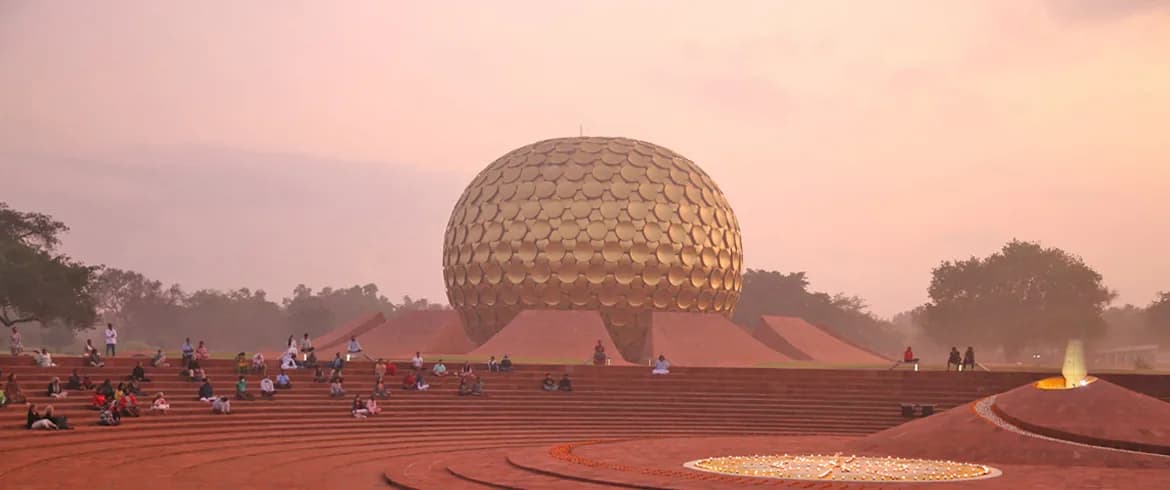
- Auroville was inaugurated on February 28, 1968, with 5,000 people present, including youth representing 124 nations, according to the organization's own account.
- The stated purpose is to 'realise human unity — in diversity,' and the organization describes itself as 'the first and only internationally endorsed ongoing experiment in human unity and transformation of consciousness.'
- The community is explicitly framed as 'not a tourist destination' but 'a live-in campus of ongoing research and development,' spanning integral education, sustainable development, farming, health and wellness, art and culture, and social enterprises.
- The Matrimandir — described as the 'Soul of the City' — is a central meditation structure open to visitors on a booking basis, run through a separate site (matrimandir.org).
Indian philosopher and yogi whose 'Integral Yoga' teachings form the stated philosophical basis for the township — a real, independently documented historical figure (1872–1950), distinct from the town's day-to-day organization.
Credited as Auroville's founder and designer of the township's physical plan — Sri Aurobindo's collaborator, independently documented.
Cited by Auroville as having issued 'statements of support' — the organization's site links to these directly; the Atlas has not yet independently reviewed the actual UNESCO resolutions referenced.
Cited as having given formal support — Auroville is in fact governed under a real Act of the Indian Parliament (the Auroville Foundation Act, 1988), which is independently verifiable and distinct from a mere goodwill statement.
EVERY NAME LINKS TO ITS PAGE ON THE MAP — SEE WHO ELSE CITES IT. NAMING A SOURCE IS NOT ENDORSING IT.
- What do the cited UNESCO and Government of India 'statements of support' actually consist of as formal documents, beyond the goodwill framing on Auroville's own site?
- What is Auroville's actual current population and land area from an independent census, versus the self-reported '3,300 people from 60 nations'?
- Auroville has a long, publicly documented history of land-acquisition and internal-governance conflict over 58 years — none of which appears on the organization's own homepage. What does that history actually look like, and how does it affect the 'human unity' framing?
Auroville is the oldest and most institutionally established entry in the Atlas by a wide margin — founded 1968, pre-dating 'pop-up village' and 'network state' language by decades, and operating under actual national legislation rather than as a private venture.
It functions as a historical anchor point for the whole Communities region: everything from Bio-Veda's planned eco-village to Edge City's month-long pop-ups descends conceptually from experiments like this one, even where the register (spiritual township vs. tech-frontier unconference) differs sharply.
The self-presentation is highly polished and institutional — official donation asks, UNESCO and Government of India branding front and center — which is exactly why the same 'aggregate the claim, name the source' discipline applies here as to any commercial product in this Atlas, not a pass because of its age or prestige.
What is Auroville's actual current population, land area, and economic self-sufficiency level, independent of the promotional framing?
Self-reported as 'over 3,300 people from 60 nations' at time of research; no independent figures located yet.
Report from the field →SeedHome
A compression-only prefab bio-shelter built from curvilinear shell geometry and decentralized robotic fabrication — the flagship product of Bio-Veda's bio-architecture academy and blueprint-licensing business.
Science and Alchemy of Consciousness (France)
A real, currently-running annual multi-day conference and retreat — its 5th year in 2025 — bringing the Implosion Group's device makers, theorists, and practitioners together at one venue for lectures, device demonstrations, and communal meals.
Edge City
A network of month-long 'pop-up villages' for people working at the frontiers of tech, science, and society — explicitly aimed at eventually seeding a permanent town.