SeedHome
A compression-only prefab bio-shelter built from curvilinear shell geometry and decentralized robotic fabrication — the flagship product of Bio-Veda's bio-architecture academy and blueprint-licensing business.
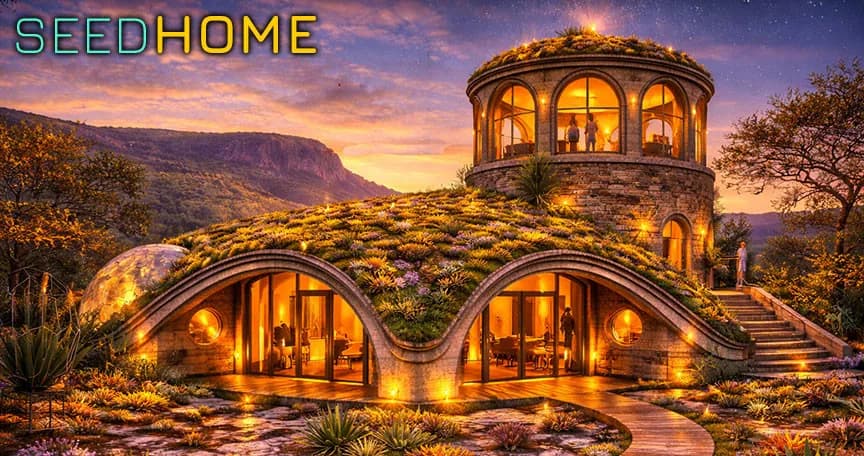
- The shell is a compression-only structure inspired by catenary, Gaudí-style geometry, described as reducing material use by up to 70% versus conventional construction while increasing structural strength.
- Homes are designed for on-site construction in 7–10 days once robotic 3D-printing/moulding fabrication is operational, using decentralized local molds rather than large fixed printing rigs.
- A built-in constructed-wetland greywater/blackwater system, modeled on the Earthship 'botanical cell,' is described as cutting water usage by up to 50% and filtering wastewater to nourish an indoor garden.
- The maker attributes wellbeing benefits to BioGeometry for EMF neutralization, cymatics for 'vibrational' design, and Vastu/Feng Shui placement principles.
- The revenue model is licensing of a patented structural blueprint, sale of robotic printer heads, training/certification of local fabrication hubs, and direct home sales.
Cited as the structural-engineering lineage behind the compression-only shell design.
Cited by name as the R&D reference for compression-only structural systems — Block's research group at ETH is a real, independently verifiable academic architecture-engineering lab.
Cited as the source of the claimed EMF-neutralization design principles. BioGeometry is Karim's own proprietary framework, not an independently peer-reviewed field.
Cited as the basis for the 'homes carry the shape of music' design framing. Noted for transparency, not adjudicated here.
The greywater wetland design is explicitly modeled on the Earthship off-grid building lineage (Michael Reynolds).
Traditional spatial-design systems cited as informing room and orientation placement.
EVERY NAME LINKS TO ITS PAGE ON THE MAP — SEE WHO ELSE CITES IT. NAMING A SOURCE IS NOT ENDORSING IT.
- Has any SeedHome unit actually been built and independently assessed, or is this still at prototype/investment-deck stage? (The maker's own site describes 'this first villa' as a prototype.)
- Is there any independent test of the BioGeometry EMF-neutralization claim specific to this structure, separate from Karim's own framework?
- What does a completed SeedHome actually cost a buyer, and how does the blueprint-licensing model translate to real unit economics?
Alosha Lynov has spent over three decades building large-scale curvilinear and bionic sculptural structures for events (up to 90,000 sq ft) and describes having trained more than 3,500 students in bio-architecture across five continents. Bio-Veda / BioArc is his academy and, with co-founder Roger D. Jones (Casa Angelitos boutique hotel, Elegancia Designs, Vía Orgánica), the vehicle for a planned BioArchitecture CoLAB eco-village in Mexico.
SeedHome is the flagship product: a single-shell compression-only home, geometrically load-bearing rather than frame-and-fill, fabricated through decentralized robotic molding. The stated aim is to remove both the debt burden of conventional construction and the centralized-factory dependency of most prefab systems.
The offering names its influences directly — Gaudí's structural geometry, ETH Zürich's compression-shell research, BioGeometry, cymatics, Vastu, Feng Shui, and the Earthship wetland system — rather than presenting the design as originating from nowhere. That transparency is itself worth noting, independent of whether each named tradition holds to the same evidentiary standard.
SOURCE: bioveda.co — /, /thevision, /seedhome (scraped 2026-07-08)
Has a SeedHome actually been built, and what did it cost end to end?
As of research date (2026-07-08), the maker's own materials describe this as prototype/investment stage — no completed, independently verified unit has been documented yet. The Atlas is tracking for the first real build.
Report from the field →Science and Alchemy of Consciousness (France)
A real, currently-running annual multi-day conference and retreat — its 5th year in 2025 — bringing the Implosion Group's device makers, theorists, and practitioners together at one venue for lectures, device demonstrations, and communal meals.
Auroville — The City of Dawn
A permanent international township founded in 1968 to 'realize human unity' — now home to roughly 3,300 residents from 60 nations, with stated support from UNESCO and the Government of India.
Edge City
A network of month-long 'pop-up villages' for people working at the frontiers of tech, science, and society — explicitly aimed at eventually seeding a permanent town.