PureWave Cell
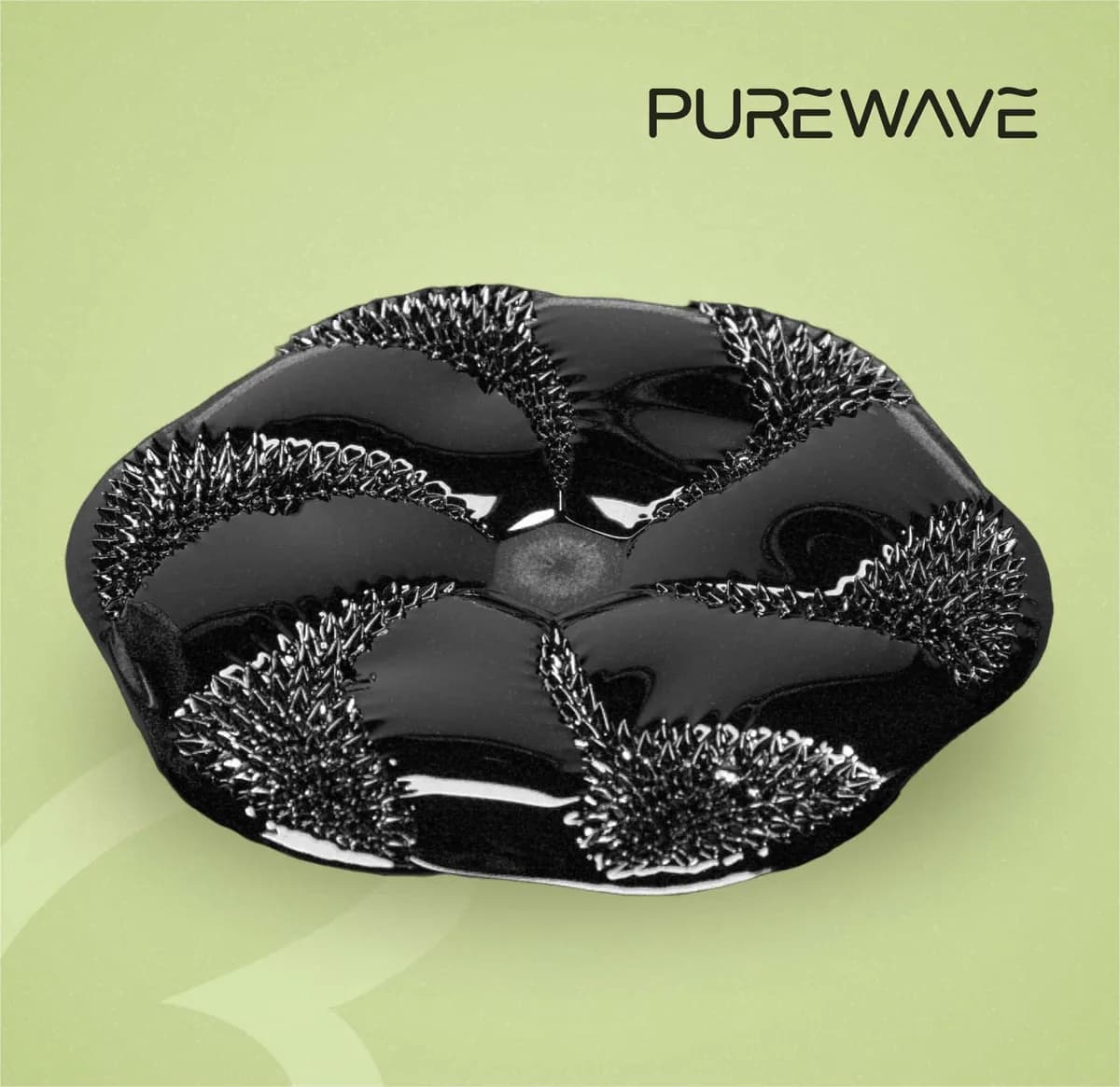
A locked array of neodymium magnets arranged on sacred-geometry principles, described as emitting a coherent low-frequency field — given free to beekeepers, sold to the public.
- A three-year study, described by the maker as published through UK bio-electromagnetic science research, is said to show colony loss falling in stages — from an industry norm of roughly 60–70% to about 30%, and to no loss at all in a third-year cohort. Across the maker's own participating hives the figure given is around 10%.
- The device is described as producing a coherent low-frequency field tuned near the ~7.2 Hz range associated with the Schumann resonance, intended to reduce electromagnetic interference rather than to treat directly.
- The construction described is twelve neodymium magnets, each around 4,000 gauss, bonded under tension into a fixed sacred-geometry array for a stated combined ~48,000 gauss. (A looser figure of 45,000 is quoted earlier in the interview and then corrected on air by the maker to 4,000 per magnet.)
- The field is described as effective to roughly 12 inches before it dissipates, so the device is said to require close contact — and to hold its strength for about 20 years without degrading.
- Human-use cases described by the maker include circulation support, sleep, EMF shielding near devices, and pathogen exposure on food — including a food-safety lab test reporting 60–100% pathogen neutralization after 5 minutes of exposure.
- The maker describes the cell as derived from a larger instrument he calls the Chrysalis Energizer — roughly 310 magnets in rotating cylinders with variable frequency — and states it has affected allergies, sight and hearing. He says he deliberately did not pursue that human-health path, to avoid conflict with the medical industry, and routed the work through beekeeping instead.
- Cells are distributed free to approved beekeepers; the mission is funded by public device and honey sales.
Referenced by maker Brent Knudsen as the published basis for the bee-immune-system claim. The Atlas has not yet located or linked the paper itself.
Cited as precedent for the idea that the body is affected by exposure to Earth's natural electromagnetic frequency range.
Cited as having tested the device against food pathogens (E. coli, Listeria) for a 5-minute exposure in the maker's own account.
The Earth-field baseline the device is described as targeting.
EVERY NAME LINKS TO ITS PAGE ON THE MAP — SEE WHO ELSE CITES IT. NAMING A SOURCE IS NOT ENDORSING IT.
- Has the bee-colony study been independently published or peer-reviewed, and can the actual paper be located and linked?
- Do the human-health uses described (circulation, sleep, pathogen exposure) have evidence beyond the maker's own account and user testimony?
- What is the real unit cost and ongoing value to a buyer, separate from the beekeeping mission funding?
- What is the Chrysalis Energizer, and can the allergy, sight and hearing effects attributed to it be examined anywhere outside the maker's own account?
Brent Knudsen spent two decades building banking algorithms before leaving finance to study what geometric form does to living systems. The PureWave Cell is the portable result: twelve bonded magnets locked in tension, tuned near the Earth's ~7 Hz resonance window.
The stated theory of action is subtraction, not cure — the field is described as quieting man-made electromagnetic interference so the organism's own repair runs uninterrupted, the same logic cited for grounding, forest exposure, and clinical PEMF.
The mission structure is the notable part: cells go to beekeepers at no charge, funded by public sales and honey. The bees are both stated beneficiary and evidence base.
On the source itself: this entry is built from a maker appearance on Stefan Burns's channel. Burns says on air that he was given the device at Cosmic Summit and that he carries a discount code for it. He discloses both himself. The Atlas records them because they are part of what this source is — not a mark against what it says.
Does it work, what does it actually cost, and for whom?
Bee-colony data: described as published, not yet independently located. Human data: anecdotal. Cost and per-use economics: not yet reported — the Atlas is collecting real numbers from owners.
Report from the field →PhiRay
A $6,900 plasma-and-magnetic-field device marketed as the direct replacement for the maker's earlier Theraphi system — claimed to be 2–4x more powerful at roughly a quarter of the cost.
Piezo Phire
The most affordable device in the Implosion Group line (700 EUR) — a piezo-based localized 'implosive charge' unit launched at the maker's own FractalU conference.
Plasmaphire
A battery-powered, portable pair of plasma spheres (2,500 EUR) explicitly marketed by its own maker as 'experimental' and unable to make medical claims — designed for use away from mains power, including outdoors.