Edge City
A network of month-long 'pop-up villages' for people working at the frontiers of tech, science, and society — explicitly aimed at eventually seeding a permanent town.
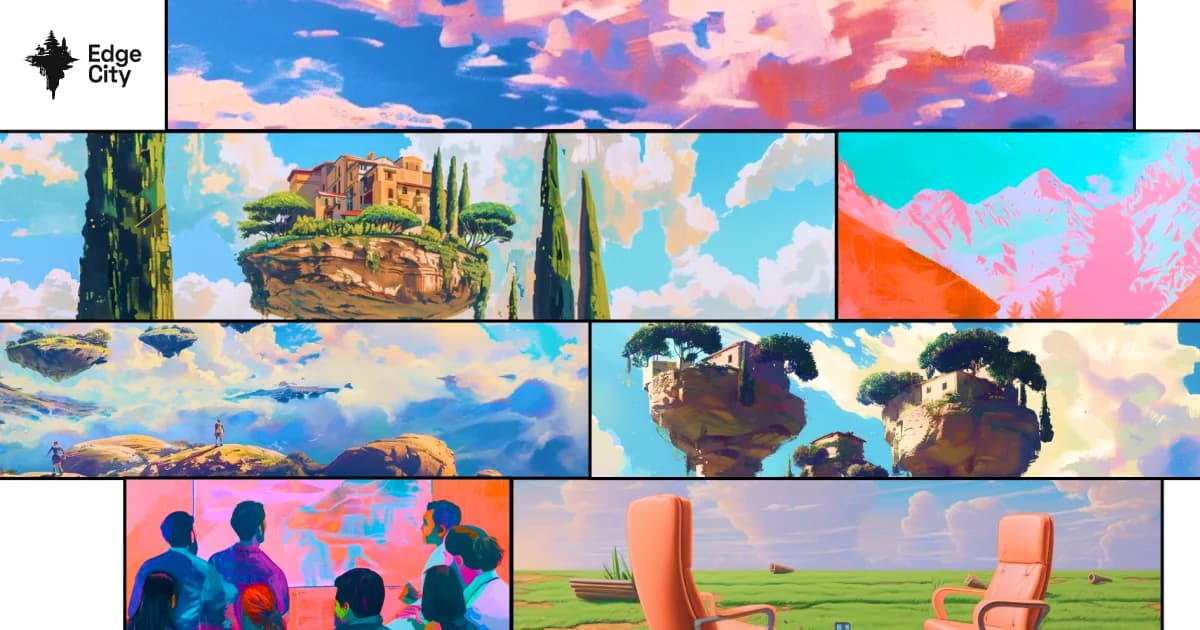
- Villages run 1–2 months in a new global location each time, gathering participants from AI, biotech/longevity, crypto, philosophy, culture, hard tech, and governance, per the organization's own description.
- Edge City states it is 'part of and contributes to the Zuzalu ecosystem' — the network-city concept associated with Ethereum co-founder Vitalik Buterin.
- The flagship annual event, Edge Esmeralda (Healdsburg, CA), is co-organized with an entity called 'Esmeralda Institute,' described as prototyping a planned permanent village roughly 90 minutes north of San Francisco.
- Named past attendees are listed directly on the site, including Vitalik Buterin, Grimes, and Laura Deming — a real, checkable list rather than a vague claim of prestige. Buterin is directly quoted: 'Edge City did an excellent job integrating diverse participants from all kinds of backgrounds... I learned a lot from my time there.'
- 2025 alone included villages in Argentina (Patagonia), Bhutan, South Africa, and the US (Austin, Healdsburg); 2026 adds an announced first village in Goa, India.
The network-state concept Edge City explicitly descends from and partners with — a real, well-documented, independently reported project (see Palladium Magazine's 'Why I Built Zuzalu').
Named with a checkable background — prior work on Zuzalu Montenegro, ZuConnect, and Gitcoin's Public Goods Funding workstream.
Named with a checkable background — prior roles at Artsy, Kama, and Seed Club Ventures.
EVERY NAME LINKS TO ITS PAGE ON THE MAP — SEE WHO ELSE CITES IT. NAMING A SOURCE IS NOT ENDORSING IT.
- Has any Edge City pop-up actually graduated participants into the planned permanent 'Esmeralda Institute' town, and if so, how many people and on what terms?
- What is the actual cost of attendance/residency, and how accessible is participation beyond the tech/crypto-adjacent, well-resourced attendee base implied by the named-attendee list?
- How does the 'micro-exit' governance experimentation described in the organization's own framing actually function during a village in practice, versus as aspirational language?
Edge City is the most direct real-world precedent for the 'frontier pop-up village' category the Atlas tracks — and, notably, was already this site's own design reference: the dotted-grid cartographic HUD aesthetic running across every page of the Atlas was extracted directly from edgecity.live during the design-anchor phase. It now earns a place as a content entry, not only a design source.
Distinct in kind from Auroville: Auroville is a single permanent, 58-year-old settlement under national legislation; Edge City is a rotating network of month-long experiments explicitly aimed at eventually seeding one permanent location. Both belong in the same region, at opposite ends of the permanence spectrum.
Has any Edge City pop-up actually graduated participants into permanent co-location, and if so how many?
The Esmeralda Institute permanent-village plan is referenced directly on Edge City's own site but not yet confirmed as built or populated in the source material pulled so far.
Report from the field →Zuzalu
A one-time, two-month 'pop-up mini-city' for roughly 200 people in Montenegro (2023) — the originating experiment that Edge City and other frontier gatherings explicitly descend from, documented firsthand by its founder.
SeedHome
A compression-only prefab bio-shelter built from curvilinear shell geometry and decentralized robotic fabrication — the flagship product of Bio-Veda's bio-architecture academy and blueprint-licensing business.
Science and Alchemy of Consciousness (France)
A real, currently-running annual multi-day conference and retreat — its 5th year in 2025 — bringing the Implosion Group's device makers, theorists, and practitioners together at one venue for lectures, device demonstrations, and communal meals.