Earthship
An off-grid house of earth-rammed tires, cans and bottles that heats, cools and waters itself. What Michael Reynolds claims, what it costs, and what people living in one report.
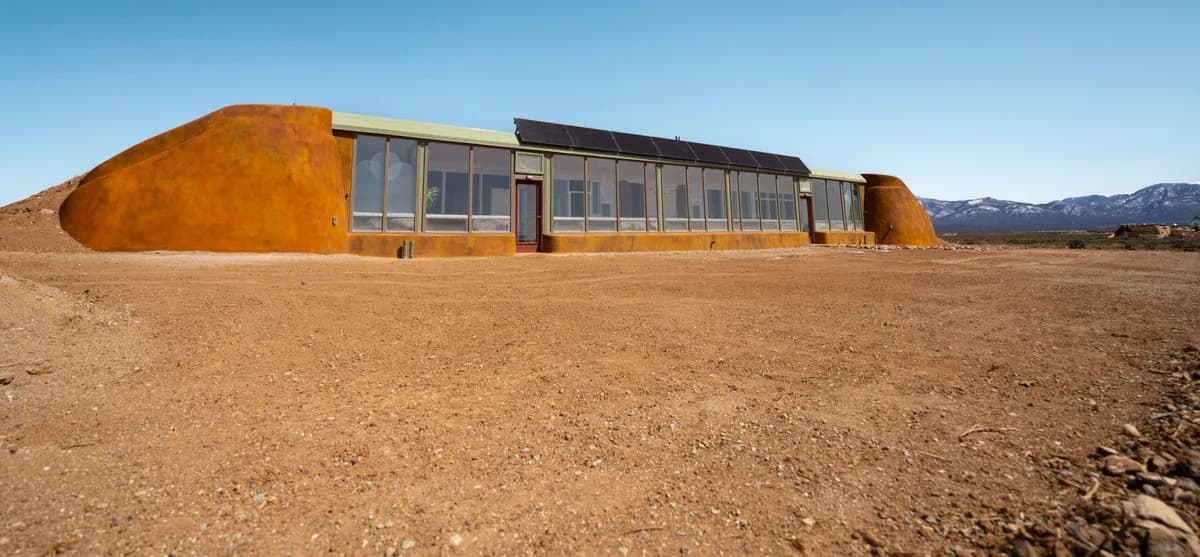
An Earthship is a house that tries to do the work of a city's utilities by itself. Its back and side walls are used car tires packed with dirt, pounded with a sledgehammer until each one is a brick of roughly 300 pounds. The walls are banked with earth, and the front is a long wall of glass angled toward the winter sun. Between that glass and the living rooms runs a planted hallway that grows food and cleans the household's used water.
Reynolds calls the practice Earthship Biotecture, which is also the name of his company. The company sells construction drawings, builds homes for clients, runs a school (the Earthship Academy, online or in Taos) and rents Earthships by the night inside the Greater World community, a subdivision of tire houses about 14 miles northwest of Taos. The name comes from the idea of a ship: a vessel that carries everything its crew needs to survive.
The house behaves "like a thermos bottle," in Reynolds' words. The mass of earth and tires stores heat from the sun during the day and gives it back at night. About four feet into the ground the temperature holds steady at around 58°F, and the house taps into that. Cooling comes from air drawn through a long buried tube under the berm and let out through a vented skylight.
Water runs off the roof through a silt catcher into cisterns, then through a filter-and-pump unit the company calls the Water Organizing Module. After a shower or a sink, that water drains into a rubber-lined planter called a botanical cell, where plants and bacteria clean it before it is pumped back to flush the toilet. Toilet water goes to a septic tank and outdoor planters. Electricity comes from solar panels, sometimes a wind turbine, into batteries.
Internal walls are often a honeycomb of cans set in concrete and plastered with adobe. The U shape of the rooms comes partly from geometry: it is hard to make a clean 90-degree corner out of rammed tires.
- Six human needs, met by the building. Earthship Biotecture says it builds "houses that address all 6 human needs": food grown inside, electricity from solar panels, water caught from rain and snow, heating and cooling from thermal mass, construction that is 50% recycled or upcycled material, and sewage and greywater treated on site.
- No operating costs: "Earthships cost very much the same as conventional housing. The difference being that you will have no operating costs when living in an Earthship."
- Comfort in extreme climates. The houses are said to hold close to 70°F (21°C) whatever the weather. Filmed in 2025, Reynolds said the inside temperature stays put whether it is 20 below zero or 104 outside.
- Water used more than once. Kirsten Jacobson, who built her own Earthship in Taos, told 60 Minutes Australia that her rain is used for showers and sinks, cleaned by indoor plants and used again to flush the toilet, and that she counts each drop as used four times. Reynolds, in a separate 2025 interview, described the same cycle as turning "that seven inches" of yearly precipitation into 21.
- Fire-resistant walls. Reynolds says a tire packed with dirt will only smoke under a blowtorch, and that an Earthship went through a forest fire with its tire walls still standing.
- No foundation needed. He describes the tire wall as wider than any footing it would need, so the wall is its own foundation.
Built her house herself. Three solar panels run her lights, TV, internet and phone, and rain is her only water. She grows banana trees indoors in a high desert that gets about eight inches of rain a year and freezing winters. "I'm missing out on not paying a utility bill."
They kept the principles and changed the details for a forested, rocky site: a rocket mass heater burning dead wood, spring water fed by gravity instead of rain, about 200 pounds of propane a year for hot water, and no fridge (they freeze water jugs in January and store them in sawdust in a root cellar, which lasts until about mid-July). Growing their own food is the goal they haven't reached: "It's a lot of work... we're getting some of our food done here but not most of it."
An hour inside Greater World. Reynolds says the community has room for about 130 homes and about 100 are built after 30 years of development. It sits about 20 minutes from Taos, which he says is what finally got people to move there. A finished Refuge model of roughly 1,700 square feet recently sold for about $500,000 to two schoolteachers. Deb, who leads the company's nonprofit builds, is building her own Refuge "out of pocket," in stages, with no loan. Reynolds' advice to viewers: "Do not get a loan." He also says he is re-fighting permits and variances he won 30 years ago because new officials don't recognize them: "I see no end in sight."
Earthship ideas carried into a wet, cold climate. Will's tire-wall greenhouse near Philadelphia had moisture problems that a solar-powered fan helped fix. Bill's house uses concrete-filled cinder block in place of tires and a 2,000-gallon cistern. On one build, officials classified the land as wetland, which the builders were told meant two to three years of special permission before a road could go in. One builder says relatives in construction are "still not convinced" the house will hold 60 to 70°F year-round.
Built the province's first Earthship about ten years earlier, fresh out of college. It has mostly been rented out, on Airbnb in summer and long-term otherwise. Nearly a decade on, the report says everything is "working as well as Cameron hoped."
Speaking about earth-bermed homes in general, not Earthships by name. Pros: protection from wind and tornadoes, quiet, light on the open side. Cons: soil sits at 95 to 100% relative humidity even in deserts, so these houses are "very prone to leaking," mold is a big concern, cross-ventilation is limited to one side, and resale value can suffer.
EACH ACCOUNT IS THEIRS, LINKED SO YOU CAN WATCH IT. QUOTING IT IS NOT ENDORSING IT.
Architect (University of Cincinnati, 1969) and founder of Earthship Biotecture. Author of Earthship: How to Build Your Own (1990), Comfort in Any Climate (2000) and Journey (2008). Per Wikipedia, his first recycled-material house, the Thumb House (1972), used beer cans wired into bricks, a design he patented in 1973.
Peer-reviewed survey of visitors to the Brighton Earthship (Buildings 11(9):377). They rated rainwater and greywater reuse, renewable energy and recycled materials as the main benefits, and rated "cheaper than an ordinary home" and "living totally off grid" among the least important. The top barriers were permits, getting a mortgage or loan, and finding a plot. The authors note their sample was already interested in Earthships, and that Earthships "have not been the focus of attention amongst the academic or professional literature."
Thermal behaviour of an earth sheltered autonomous building: the Brighton Earthship. Cited on Wikipedia as the thermal research on the Brighton build. The Atlas has not yet read the paper itself.
Architect and authority on earth-sheltered design, cited on Wikipedia for recommending insulation between deep soil and heated rooms. Soil insulates poorly (about R-1 per foot), and Wikipedia attributes some Earthships' winter heat loss to thermal mass being mistaken for insulation.
The UK book on the Brighton Earthship project.
Wikipedia reports that the first Earthship completed in Germany (Tempelhof/Kreßberg, 2015 to 2016) was built with more insulation and fewer thermal bridges in cooperation with a Fraunhofer institute, to prevent mould.
The film on Reynolds and his fight over permits to build from unconventional materials, off the grid.
Used as an aggregator of the record. Several sections of the Earthship article carry "needs citations" warnings, and the passage about Reynolds' licence is flagged there as disputed. Both are noted where used.
EVERY NAME LINKS TO ITS PAGE ON THE MAP — SEE WHO ELSE CITES IT. NAMING A SOURCE IS NOT ENDORSING IT.
1969 to 1973: Reynolds graduates, builds the Thumb House from cans and patents the can brick. Through the 1970s the tire-wall, U-shaped design takes form in the Taos desert. 1990: after a year-long dispute with clients over defects such as leaky roofs and poor climate control, Reynolds gives up his New Mexico architecture and construction licences (Wikipedia; passage flagged there as disputed). 2007: Garbage Warrior is released and his licence is reinstated after a 17-year fight. Reynolds says he introduced a state law allowing test housing, which he calls the New Mexico Sustainable Testing Sites Act, signed by Governor Bill Richardson.
Abroad: the first UK Earthship opened at Kinghorn Loch, Scotland, in 2004, and one in Stanmer Park, Brighton, in 2005. France had a permitted Earthship by 2007, and Olst in the Netherlands finished a 23-home Earthship district in 2014. There are builds in South Africa, Malawi, a school in Sierra Leone (2011), Ushuaia in Argentina (2014), a public school in Uruguay (2016), Belize, Guatemala, Australia and New Zealand.
Earthship Biotecture's own estimates: Refuge and Encounter models about $350 per square foot, Unity about $400, the Global Model about $425. Construction drawings are sold through the Earthship store. A 30-minute consultation with Michael Reynolds costs $300. Reynolds told Santenello the glass alone in one build cost about $10,000.
The Earthship Academy runs online or in person in Taos, with hands-on practice builds and a diploma.
Nightly rentals in the Greater World community run from $210 a night (a one-bedroom Refuge) to $520 a night (the whole Phoenix, sleeping six) outside the holidays, plus New Mexico tax and a cleaning fee. Two-night minimum; the company says they book up months ahead. The Visitor Center near Taos offers tours.
Finished Earthships and land in the Taos community are listed by the company. The one sale price on record here is the roughly $500,000 Refuge Reynolds mentioned on camera in 2025.
PRICES ARE THE MAKER'S OWN, AS PUBLISHED ON THE DATE PULLED. CHECK BEFORE YOU BOOK.
- How do Earthships perform outside the high desert? Wikipedia reports moisture and mould in some European builds and winter heat loss into the ground in cloudier, wetter places; the German build added insulation for that reason. Is there measured, multi-year data from a wet climate?
- Do the tires leach? Belgium bans tires as a building material over the risk of lead and zinc leaching, according to Wikipedia (citing EOS magazine), and Belgian builders use earthbags instead. Has anyone tested soil or air around tire walls after decades?
- Is it cheaper? The company says it costs about the same as a conventional house and then nothing to run. What do ten years of real running costs look like, counting batteries, propane and repairs?
- The water math differs by teller: seven inches made into 21, or eight inches used four times. How much water does an actual household use in a year, and how often do cisterns run dry?
- Can you finance and insure one? Permits and mortgages were the top barriers in the only peer-reviewed survey, and Reynolds' own advice is not to borrow at all.
What did your Earthship cost per square foot, where was it built, and what does it cost to run each year?
The maker quotes $350 to $425 per square foot depending on the model. One sale price is on record: about $500,000 for about 1,700 square feet in Taos (2025, per Reynolds on camera). No independent running-cost data yet.
Report from the field →SeedHome
A compression-only prefab bio-shelter built from curvilinear shell geometry and decentralized robotic fabrication — the flagship product of Bio-Veda's bio-architecture academy and blueprint-licensing business.
Science and Alchemy of Consciousness (France)
A real, currently-running annual multi-day conference and retreat — its 5th year in 2025 — bringing the Implosion Group's device makers, theorists, and practitioners together at one venue for lectures, device demonstrations, and communal meals.
Auroville — The City of Dawn
A permanent international township founded in 1968 to 'realize human unity' — now home to roughly 3,300 residents from 60 nations, with stated support from UNESCO and the Government of India.